
Gear / Industry
Sony Is Trying to Buy Tamron: What It Could Mean for the Lenses You Own
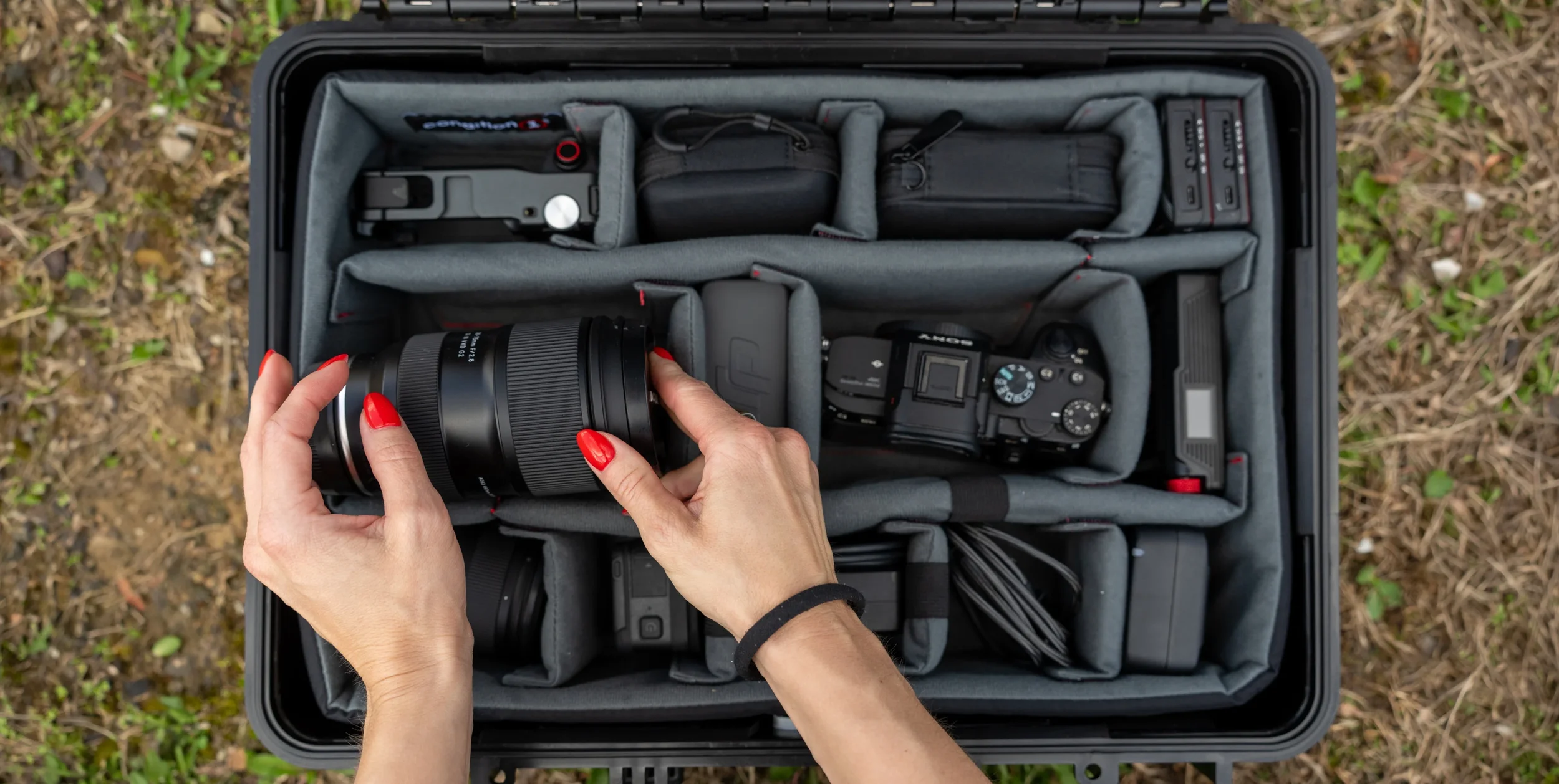
Sony buying Tamron is a bigger question for photographers than the corporate transaction suggests, because most of the good third-party glass in this industry has a Tamron badge or Tamron engineering behind it. I am a Tamron Americas Ambassador and have been since 2017, and I shoot these lenses on paid client work every week. That is my disclosure and it is also why I care about the answer.
On July 30, 2026, Tamron confirmed a non-binding proposal from Sony Group to acquire the company and make it a wholly owned subsidiary. Sony confirmed the proposal in its own Q1 FY2026 results on August 2, 2026.
My short answer: I would not stop buying a lens I need today over a transaction that has not closed. I would absolutely watch what both companies say next.
I use Tamron glass on real assignments, including commercial product photography and facility work where the focal range I have on the body directly decides what I can deliver. That is the perspective here, not an investor's.
What has actually happened
Tamron formed a special committee to evaluate the proposal. Reporting put the offer at roughly 200 billion yen, about $1.2 billion at the exchange rates quoted at the time, though neither company published terms.
The trigger appears to be shareholder structure rather than product strategy. Sony has been Tamron's largest shareholder for years, sitting at 15.35 percent. Effissimo Capital Management, an activist fund with a track record of pushing Japanese corporate restructurings, accumulated Tamron shares to 17.38 percent by March 31, 2026 and passed Sony for the first time.
If you have held a comfortable minority position for years and somebody else takes it, a formal bid is not a surprising response. That context is missing from most of the coverage and it explains the timing better than any product theory.
Why Sony would want Tamron
From the outside, the logic is not hard.
Tamron has optical engineering, manufacturing capability, a strong consumer brand and a lineup that reaches photographers Sony does not reach with first-party glass alone. It has also become extremely good at finding focal ranges the camera manufacturers either do not offer or do not offer at the same combination of size, price and aperture.
The 35-150mm f/2-2.8 is the obvious example. There is nothing else like it, and it has been on my camera more than any other lens. The newer 35-100mm f/2.8 does the same trick in a lighter package. The 12-20mm F2.8 pushes full frame ultra wide coverage into a range nothing else occupies at that price.
That is a real asset. The question is what Sony sees when it looks at it.
Does this mean Tamron becomes Sony only?
Nobody should state that as fact, and several people have.
Tamron currently serves Sony E, Nikon Z, Canon RF and Fujifilm X. It has been actively expanding beyond E-mount, not retreating. The 12-20mm F2.8 launched for Sony E on July 30, 2026 and Nikon Z on August 27. The 17-70mm f/2.8 came to Nikon Z and Canon RF in 2026.
Abandoning those customers would be a strategic decision with real revenue attached, not an automatic consequence of a change in ownership. Could Sony eventually prioritise E-mount? Of course. Could Tamron continue as a distinct multi-mount brand? Also plausible. Until one of the two companies publishes a roadmap, anyone claiming to know is guessing.
What Nikon Z shooters should watch
Nikon users have the most exposure here, simply because Tamron has been building out Z-mount presence most aggressively.
If I shot Nikon and was considering one of those lenses today, I would evaluate the product that exists rather than an imaginary future strategy. A lens does not stop working because ownership changes. The longer-term questions are new lens development, firmware support, service and if new designs keep appearing on the mount, and none of those have answers yet.
What Canon RF shooters should watch
Canon is the interesting case, because third-party autofocus availability on RF has historically been tightly controlled. Tamron's recent RF activity makes this proposal more relevant to Canon shooters than it would have been three years ago.
Same principle applies. Separate existing products from future strategy. If a lens is officially supported on your camera and solves a problem today, that is real. A hypothetical roadmap three years out is not.
Should you buy a Tamron lens right now?
If you need it, yes. I would not delay paid work because investors are negotiating ownership of the company that made my lens.
The purchase decision should still start where it always did. Does this focal range solve a problem. Is the optical performance good enough. Is autofocus good enough. Does it fit the workflow. Is the price justified. Will I actually use it.
Corporate uncertainty deserves weight when it affects support or availability. Nothing about this proposal puts Tamron glass anywhere near unsupported territory.
The Tamron lenses in my working kit
The lens that stays on the a1. One body, one lens, and I can cover a room, a plate, a portrait and a product detail without a swap. Nothing else does this range at this aperture.
The lighter sibling. Half the weight of the 35-150 and it covers the focal lengths I use most on a long shoot day. I wrote a full comparison of the two.
My ultra wide for facilities, interiors and anything where the room decides where I stand.
Product detail, texture, food and anything where the client wants to see the material rather than the object.
The newest one, and useful context for this story. Tamron launched it across two mounts weeks before the acquisition proposal became public.
The 12-20mm is the detail worth noticing
Tamron announced the 12-20mm F2.8 for Sony E and Nikon Z on July 15, 2026. The acquisition proposal surfaced two weeks later.
That is not nothing. A company preparing to abandon its multi-mount strategy does not launch a flagship ultra wide on two mounts a fortnight before the news breaks. The product pipeline says multi-mount. Until something contradicts it, I weight the pipeline over the speculation.
I compared that lens against the 16-30mm f/2.8 G2 in a separate article.
My existing 16-30mm f/2.8 G2 review covers the lens I actually run.
Five things I am watching
- If the proposal becomes a binding transaction
- If Tamron remains a separately operated brand
- If Tamron publicly commits to its current non-Sony mounts
- If product roadmaps change
- If service, warranty or firmware policies change
Those matter more to a working photographer than the price. Until they are answered, I would avoid treating speculation as product advice.
The right response is attention, not panic
This could turn into one of the most significant changes in the third-party lens market in years. It could also close quietly and change very little that a photographer notices.
Until the deal and the strategy are defined, buy equipment for the work you need to create now, not for a roadmap nobody outside the two companies has seen.
Commercial Photography and Video
The gear matters less than what gets delivered
Product, food, automotive, industrial and brand content for companies that need images built for how they are actually used. Pittsburgh based, shipped product work nationwide.
Start a ProjectFAQ
Is Sony buying Tamron?
Sony submitted a non-binding proposal to acquire Tamron and make it a wholly owned subsidiary. Tamron confirmed it on July 30, 2026 and formed a special committee to evaluate the offer. Sony confirmed the proposal again in its Q1 FY2026 results on August 2, 2026. As of August 2026 it is a proposal, not a completed transaction.
How much is Sony offering for Tamron?
Reporting put the figure at roughly 200 billion yen, which is about $1.2 billion at the exchange rates quoted at the time. Neither company has published financial terms, so treat that number as reported rather than confirmed.
Why is Sony making an offer now?
Sony has been a major Tamron shareholder for years at 15.35 percent. Activist fund Effissimo Capital Management accumulated shares to 17.38 percent by March 31, 2026, passing Sony as the largest shareholder. A formal bid is a reasonable response to losing that position.
Will Tamron become Sony E-mount only?
Nobody outside the two companies can say. Tamron currently makes lenses for Sony E, Nikon Z, Canon RF and Fujifilm X, and it launched new products across multiple mounts in 2026, including the 12-20mm F2.8 for both Sony E and Nikon Z. Dropping other mounts would be a strategic decision, not an automatic consequence of ownership.
Should I still buy a Tamron lens right now?
If the lens solves a problem in your work today, yes. A lens does not stop working because ownership changes, and I would not delay paid work over a transaction that has not closed. Buy on focal range, optical performance, autofocus and price, the same as always.
What should Nikon Z and Canon RF shooters watch?
Five things: if the proposal becomes binding, if Tamron stays a separately operated brand, if Tamron publicly commits to non-Sony mounts, if product roadmaps change, and if service, warranty or firmware policies change. Until those are answered, existing products are real and future roadmaps are speculation.
My Tamron coverage: the 35-100 vs 35-150 comparison, the 35-100mm review, my 35-150mm review, why the 35-150 stays in my bag, the 90mm macro on the a1, and the 16-30mm G2 review. Current kit lives on my gear page, and the features are on my press page.
Sources: Tamron corporate statement confirming a non-binding proposal from Sony Group, July 30, 2026. Sony Q1 FY2026 financial results confirming the proposal, August 2, 2026. Reuters and Diamond Online reporting on the approximate transaction value. Tamron shareholder disclosures covering Sony at 15.35 percent and Effissimo Capital Management at 17.38 percent as of March 31, 2026. Tamron product announcements for the 12-20mm F2.8 and 17-70mm f/2.8.